Automate the manual work,connect your systems
For businesses where the same data gets typed into three places, and the work runs through more tabs than anyone can keep track of.
Who itis for
The tools you use are usually fine on their own. The time goes in between: copying an order into a spreadsheet, a spreadsheet into an invoice, a price into the shop. That in-between is what we automate.
“I’m drowning in manual work”
Automations that move data between the tools you already use, so nothing is typed twice.
- Automations
- Integrations
- Internal tools
“I’ve outgrown my spreadsheets”
One platform for the whole operation: stock, photos, descriptions and publishing in one flow instead of ten tabs.
- Custom platforms
- Admin panels
- Shopify
What wedo
Data that moves on its own
What you now copy by hand from one tool to the next runs by itself, the same way every time.
Integrations
We connect the systems you already pay for, as far as they allow it, and check what each one allows before we promise anything.
Internal tools and admin panels
A tool made for your team: an approval flow from draft to approved, an activity log, reports.
One platform instead of ten tabs
When spreadsheets are no longer enough: stock, photos, texts and publishing in one flow, with Shopify as the hub if that is where you sell.
AI where it does a real job
Writing product texts in two languages, turning rough notes into clean lines. Only where it saves time.
Slow jobs in the background
Imports, images and AI texts run in a queue in the background, so the tool stays quick for the people using it.
Work thatshows it
A platform for a watch reseller
Imports from partner catalogues with price and availability checks, photo processing, an approval flow, AI-written descriptions in English and Swedish, and publishing to Shopify. The client is private, so we don’t name it.
Made together with Frostlight Solutions, the studio that brought the project and leads the work with the client.
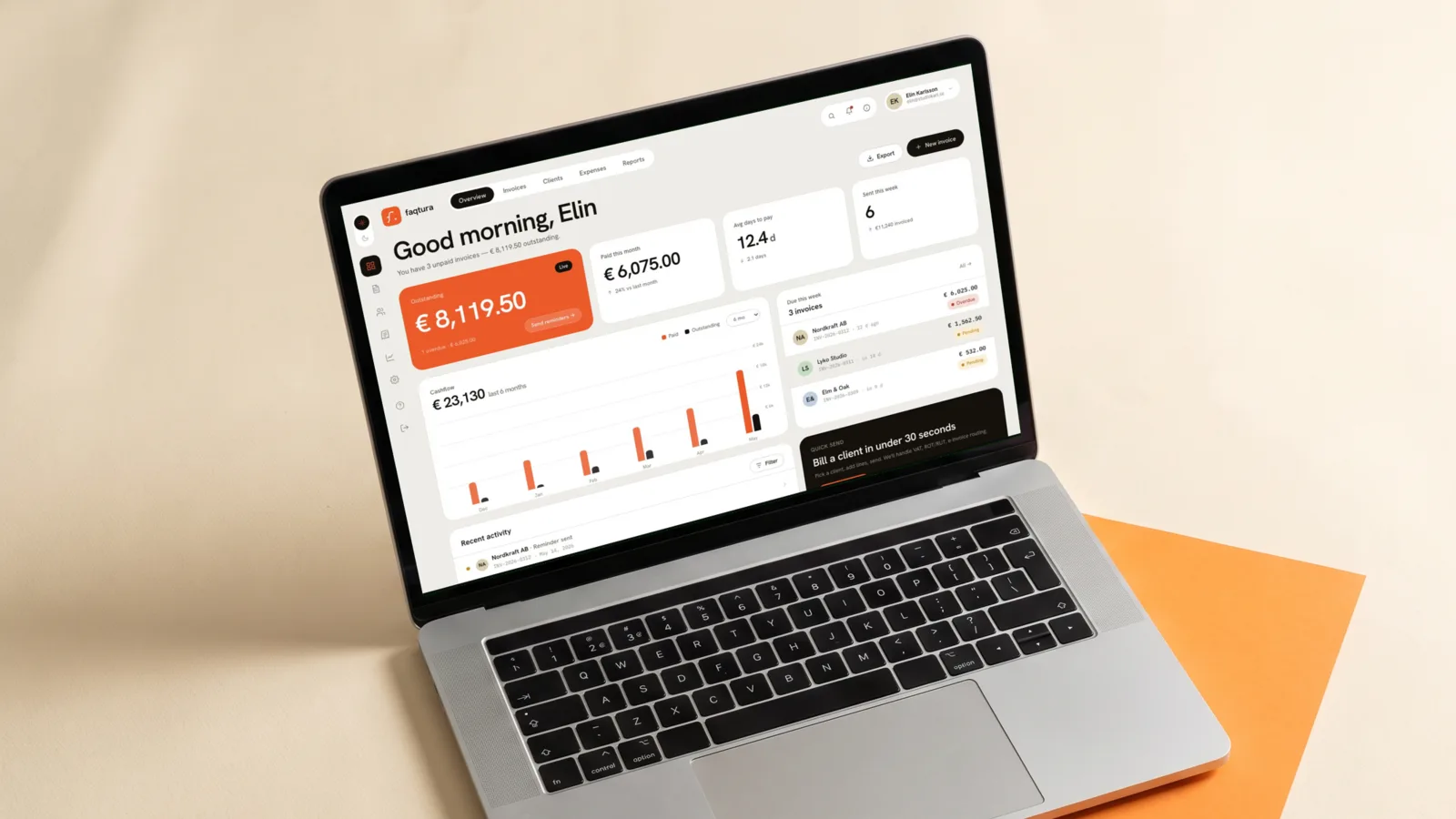
Faqtura
Invoicing for Swedish freelancers: VAT, ROT and RUT, OCR payment references, and AI that turns rough work notes into invoice lines.
What wedon’t do
We check before we promise
Fortnox, Shopify, a booking system or a CRM: what can be automated depends on what each one allows. We find out first.
No time-saved numbers
We describe what will run on its own, not how many hours it is worth. You know your week better than we do.
No automating for its own sake
Only what saves time or money is worth building. A step you do twice a year can stay manual.
How itruns
- Step 1
A short call
We talk about the problem in your business, not about tech. Then you get a plain written scope: what gets built, by when, for what price.
- Step 2
Design, then build
First a clickable design you can try, then the real thing. You see progress every week, not at the end.
- Step 3
Launch and hand over
It goes live and it is yours: the code, the accounts and short notes on how it works. Support after that is there if you want it.
Questionsand answers
Can you connect to my accounting or booking system?
It depends on what that system allows, and we check it before promising anything. If something can’t be connected, you hear it before any work starts.
Do I have to switch tools?
No, the idea is to keep the tools you know and let them work together. A new platform only makes sense when the old way has stopped holding up.
What happens when something goes wrong?
It is built to tell a person instead of guessing. On the watch platform, when a partner stops listing a watch that is already published, the operator gets a flag; the listing is not deleted on its own. Support after launch is there if you want it.
Where do we start?
With the task that eats the most time. A small first version comes first, and grows once it works for real.
Who owns what is built?
You do: the code, the accounts and the notes on how it works. Nothing stays locked on our side.
What do you typetwice every week?
Tell us what eats your week.
You get a plain answer, not a sales pitch.
Let's talkor email hello@dwhytestudio.com